I wanted to know whether my standard template for investor decks holds up against data. I normally tell coachees to use the DocSend structure, business language and short bullet lists. But does this actually help?
So with a lot of help from Claude, I rated 4,081 public startup decks on twelve content pages and six readability rules. For a sample of 1,000 companies we then traced the funding record, through Crunchbase, SEC filings and manual search. For 68% of them we could identify the company and its funding record with certainty. For 264 early-round decks we also knew when the deck was written, so we could check whether a funding round followed.
Results: Completeness told us little. Of the companies whose deck had 10 to 12 of the 12 pages of the template, 64% raised a round. With 7 to 9 pages it was 69%. That difference is within chance.
Two things did make a difference:
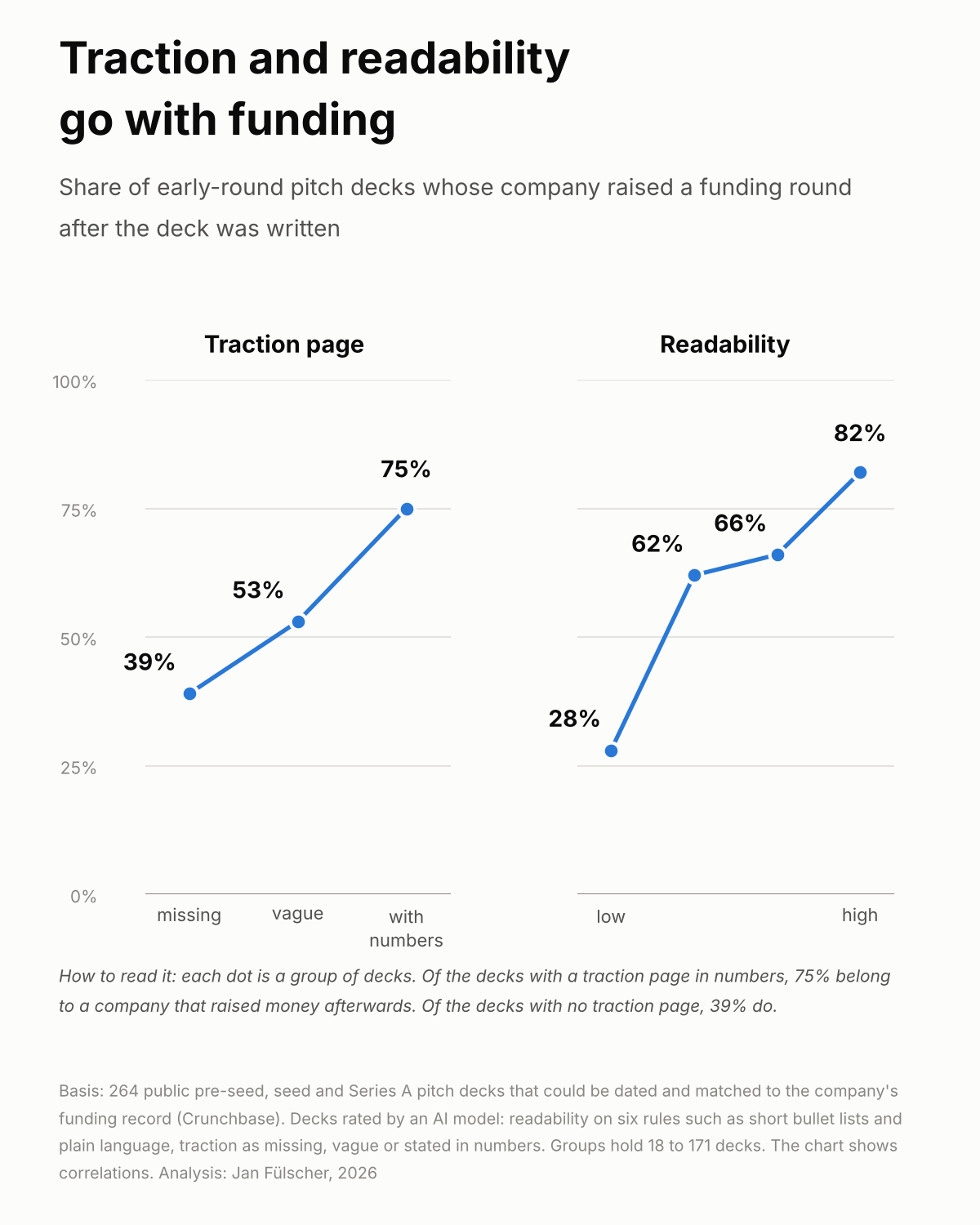
- Where the deck had a traction page with numbers, 75% raised afterwards. With a vague traction page it was 53%, and with none 39%.
- Readability shows the same pattern: 82% at the top of our scale and 28% at the bottom. The rules that mattered most were short bullet lists and plain business language.
Two cautions: these are correlations, and public decks are often shortened before they go online. So, use all pages of the template, to be on the safe side.
Nevertheless: Proof and clarity seem to matter more than completeness.